
When I say that I get obsessive, I mean it. Over the last 24 hours, I devoured the (unfortunately small) Dykes to Watch Out For archives and two of the several strip collections Bechdel put out, only a few of which are available online, since they've been out of print for a very long time, and I'm currently losing my shit as I'm waiting to move forward in the queue on OpenLibrary.org to access the other two collections available there.
All of this started because I was catsitting for my friends, who happened to own a copy of Bechdel's graphic memoir about her dad, Fun Home. I like graphic novels, but I rarely read them, because they have a tendency to be expensive and, overall, kinda short - not more than an evening read. Fun Home was a lot denser than I expected it to be, packed with literary references, non-linear narrative structures and observations that clearly had a lot of time to gestate in Bechdel's head and develop into a deeper understanding of her family. Bechdel has a fascinating tendency to record time through books, which often lay scattered around her characters, indicating both the time period and their interests and after finishing the memoir, I went back and made a list of every book depicted visually or mentioned in the text - and there sure is a lot of text in this book compared to other graphic novels I've read. It's a neat balance where neither medium takes precedent, but exists in a way that is mutually complimentary. It's clear that Bechdel at this point has spent a lot of time thinking about comics as a medium and she really achieves something I haven't seen before, even in some of the more literary graphic novels, like Persepolis or Maus.
Perhaps the most amazing thing about reading Dykes to Watch Out For for the first time in 2019 is how similar the lesbian community is to what it was like some thirty years ago. The stereotypes are still very similar, our internal struggles and concerns, it just rings true to both my experiences and those of my lesbian and bi friends.

 |
Example - we still take forever to realise that the girl we're into likes us back
|
Are we just stuck in an endless cycle where, because various queer generations don't interact the same way generations do within biological families, each subsequent generation of queer people has to go back and actively rediscover everything the came before them? How difficult does that make it for us to create stable communities that can enact radical politics when we spend so much time figuring out things that people have already dealt with in the decades prior? I think we honestly need to get better at archiving not just our historical artifacts, but our cultural artifacts as well. This doesn't mean that queer elders are always right or that their politics are never problematic - hell, I have my disagreements with some of Bechdel's politics, which seem to have become more centrist compared to the tone of her 80s and 90s comics - but that we need to learn to listen and maybe invite them to share their experiences.
One thing is for sure, our experiences tie us together and we don't have to fight our fights on our own. There is strength in who we are and what we've all been through that we can mutually draw on. Our fears are nothing new, neither are our sensibilities. As I write this post, there's a sealed envelope on my desk with a letter for Alison Bechdel. Since the success of Fun Home, it seems that she only accepts fan mail in physical form and I want to let her know how much her work means to me - it feels joyfully archaic to send a letter to my lesbian ancestor, but the contents are the same as an email would be. Sometimes, things only change on a surface level - paper or digital, 1987 or 2019 - but at their core, they remain the same.
One thing is for sure, our experiences tie us together and we don't have to fight our fights on our own. There is strength in who we are and what we've all been through that we can mutually draw on. Our fears are nothing new, neither are our sensibilities. As I write this post, there's a sealed envelope on my desk with a letter for Alison Bechdel. Since the success of Fun Home, it seems that she only accepts fan mail in physical form and I want to let her know how much her work means to me - it feels joyfully archaic to send a letter to my lesbian ancestor, but the contents are the same as an email would be. Sometimes, things only change on a surface level - paper or digital, 1987 or 2019 - but at their core, they remain the same.
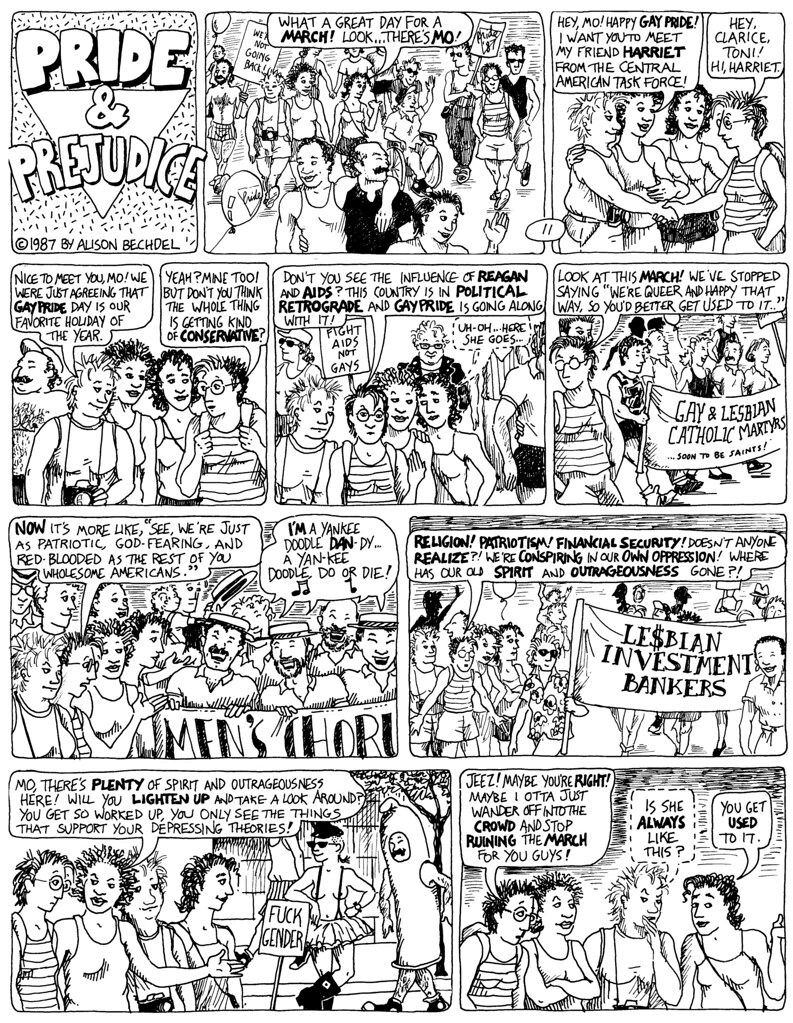 |
| And yeah, in case you're wondering, I'm definitely a Mo. |

No comments:
Post a Comment